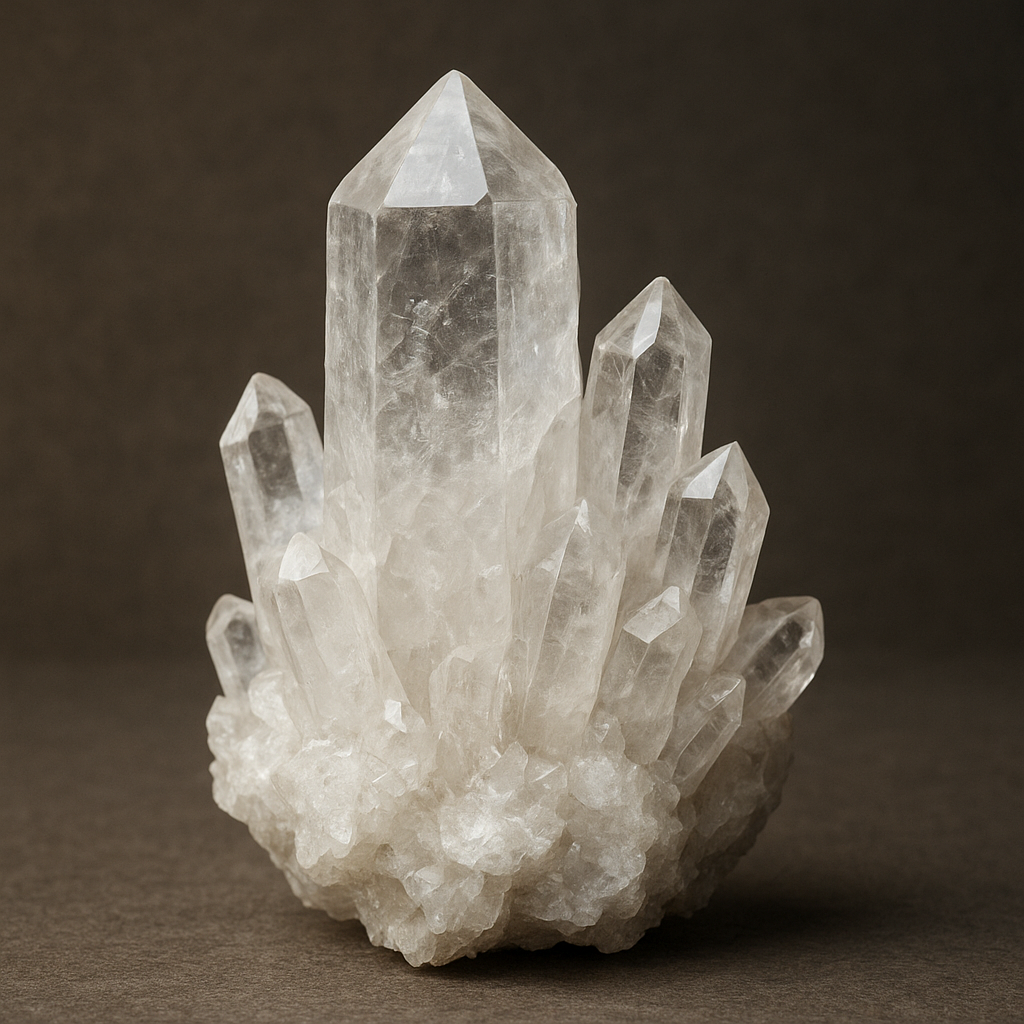

Among collectors, crystal healers and geologists alike, Herkimer Quartz has earned an almost legendary status. These small yet striking crystals, famed for their exceptional clarity and natural faceting, embody a fusion of scientific fascination and metaphysical allure. Although often called diamonds, they are in fact a special variety of **quartz** whose origin, structure and uses make them a remarkable subject of study and admiration.
Geological origin and occurrence of Herkimer Quartz
Herkimer Quartz takes its name from Herkimer County in New York State, USA, where these crystals were first described and where the most classic localities are still found. The host rocks are primarily dolostone of the Cambrian and Ordovician periods, formed over 450 million years ago. Within this relatively soft sedimentary matrix, cavities known as vugs or drusy pockets developed over immense spans of geological time. Inside these hollow spaces, silica-rich fluids slowly precipitated quartz, allowing crystals to grow freely without strong external pressure.
The result is the characteristic doubly terminated crystal habit: instead of being attached to a rock base, the crystals are naturally terminated at both ends. This happens when growth is unrestricted in multiple directions inside an open cavity. As the silica solution remained stable and relatively undisturbed, crystals could develop remarkably well-defined faces, often with high symmetry and high optical clarity. Many specimens are almost water-clear, with brilliant internal reflections that create a diamond-like sparkle, which inspired miners and traders to call them “Herkimer diamonds”.
The dolostone host rock itself contributes to the unique formation conditions. It is moderately porous and able to hold mineral-rich fluids, but also susceptible to fracturing, which creates pathways and spaces for fluid circulation. Over time, repeated phases of mineralization, slight shifts in chemistry and temperature, and episodic opening of micro-fractures allowed multiple generations of quartz deposition. Some Herkimer Quartz crystals therefore show subtle internal zoning, phantom layers, or inclusions that record their growth history and shed light on the ancient hydrothermal system that produced them.
Although Herkimer County is the classical and legally protected origin of the name, very similar doubly terminated clear quartz crystals occur in other parts of the world. Localities in Afghanistan, India, China, Pakistan and parts of Europe produce quartz that visually resembles Herkimer specimens. However, purists reserve the name Herkimer Quartz or Herkimer diamond strictly for crystals from the original New York region. This geographic connection matters not only for reasons of tradition, but also because the specific geological setting of the Mohawk Valley dolostones imparts recognizable characteristics: typical size ranges, surface etching patterns, inclusions, and association with other minerals such as calcite, pyrite and drusy quartz coatings.
Mining Herkimer Quartz is often carried out by small-scale operations and hobby collectors. Because the crystals sit inside cavities within the dolostone, extraction requires a combination of heavy tools to break the rock and precise hand work to avoid damaging the fragile terminations. Many mines in the region operate as “pay-to-dig” sites, where visitors can buy access to quarry areas, use basic tools and keep whatever crystals they find. This has helped build a strong tourism and collector culture around the stone, further increasing its renown in the mineral world.
Physical, optical and structural characteristics
From a strictly mineralogical perspective, Herkimer Quartz is composed of silicon dioxide (SiO₂), the same chemical formula as any other quartz variety. Its hardness on the Mohs scale is 7, making it durable enough for many types of jewelry and everyday handling. The crystals have a trigonal crystal system and usually display the classic prismatic habit associated with quartz, but with two well-developed terminations instead of one terminated end and one attached base. This doubly terminated form is one of the defining features and a key reason for the aesthetic appeal of these crystals.
Optically, Herkimer Quartz is famous for its clarity and brilliance. Many crystals are exceptionally transparent, with minimal visible internal fractures. When light passes through a high-quality specimen, it often creates sharp reflections and bright internal highlights. Some stones display rainbows caused by tiny internal stress fractures or thin-film interference along microscopic planes. These rainbow flashes are particularly prized in the metaphysical community, where they are often interpreted as amplifiers of the crystal’s energetic properties.
Inclusions are another fascinating aspect. Although the most sought-after Herkimer crystals are nearly flawless, many specimens contain minute inclusions of hydrocarbons, water, carbon dioxide bubbles or other minerals. Some inclusions appear as tiny black specks, sometimes called “tar” inclusions, which are actually trapped organic material from ancient marine environments. Others hold fluid inclusions that move visibly when the crystal is tilted, demonstrating that pockets of ancient liquid remain sealed inside the quartz. These features not only enchant collectors but also provide scientists with valuable information about the chemical and thermal conditions present when the crystals formed.
Surface characteristics also deserve attention. Many Herkimer Quartz crystals show slight pitting, natural etching or skeletal growth patterns on their faces. These textured surfaces can scatter light in intricate ways, enhancing the play of reflections. Some crystals are coated with a thin druse of micro-quartz or calcite, adding a sparkling appearance and suggesting that they remained in active mineralizing environments even after the main crystal had largely finished growing. Twinned crystals, clusters of intergrown points, and “bridge” formations where one crystal passes through another are common structural curiosities that further expand the diversity of available specimens.
The combination of high hardness, clarity and durability makes Herkimer Quartz suitable for a variety of lapidary applications. Cut stones, cabochons, drilled beads and faceted gems can be made from suitable material. However, many enthusiasts prefer to keep well-formed crystals in their natural state, considering the double termination and undisturbed growth faces to be integral to the stone’s identity and power. For collectors and metaphysical practitioners alike, the untouched crystal is often believed to hold a stronger and more harmonious **vibration** than a heavily modified one.
Metaphysical properties and energetic applications
Beyond their geological interest, Herkimer Quartz crystals occupy a prominent position in the realm of crystal healing and metaphysical practice. They are widely regarded as powerful amplifiers of **energy**, often described as more vibrant than ordinary quartz points of similar size. This reputation stems largely from their clarity and double terminations, which are believed to facilitate multidirectional flow of subtle energy and information. In many traditions, quartz itself is considered a master healer and energetic amplifier; Herkimer Quartz is then seen as an especially potent subset of this larger family.
In meditation practices, these stones are frequently used to enhance clarity of thought, deepen states of inner stillness and support intuitive insight. Practitioners may hold a crystal in each hand, place one over the third-eye region of the forehead, or arrange a small grid of points around their seated posture. The double terminations are thought to allow simultaneous reception and projection of subtle signals, making the stones popular tools for both inward reflection and outward energetic work. Many people report that Herkimer crystals feel more stimulating than softer, more grounding stones, and thus they are often recommended for advanced or focused sessions rather than casual relaxation.
Herkimer Quartz is commonly associated with alignment of the higher **chakras**, particularly the third eye and crown. In chakra-based systems of energy work, these centers are linked to perception, intuition, spiritual connection and the integration of subtle knowledge. By placing a Herkimer crystal near these areas, healers intend to open, clarify and harmonize the flow of energy, allowing the user to better sense inner guidance or connect with states of heightened consciousness. Some practitioners also position Herkimer Quartz at the heart chakra to integrate spiritual insight with emotional intelligence, fostering compassionate clarity rather than detached analysis.
Another widely discussed property is the stone’s reputed ability to amplify the effects of other crystals. Many practitioners will combine Herkimer Quartz with colored or specialized stones, expecting that the quartz will intensify the partner’s specific qualities. For instance, pairing it with rose quartz is said to strengthen emotional healing and self-love, while combining it with black tourmaline is believed to enhance grounding and protection during intense energetic work. In crystal grids, Herkimer pieces are often placed at key points of intersection or at the central node, where their supposed amplifying function can influence the entire layout.
Dreamwork and lucid dreaming are additional areas where these crystals are frequently employed. Because of their association with clarity and perception, some users place a small Herkimer crystal under the pillow or on a bedside table, intending to remember dreams more vividly or to recognize when they are dreaming. Reports from enthusiasts include more colorful or detailed dream imagery, increased instances of lucid awareness and smoother recall upon waking. While such experiences are anecdotal and vary widely from person to person, they have contributed to the crystal’s reputation as a bridge between waking and subtle states of consciousness.
Energetic cleansing and attunement practices also feature Herkimer Quartz. These stones are often used to “charge” environments, tools or even other crystals. A practitioner might place a Herkimer point on top of a deck of tarot cards, next to a journal, or in the center of a personal altar, with the intention of clearing residual influences and imprinting the space with focused, high-frequency energy. Because of their relative hardness and resistance to weathering, they can also be placed outdoors for gridwork around homes, gardens or ceremonial sites, where they are believed to anchor light and maintain a stable energetic field.
It is important to distinguish between metaphysical claims and scientifically established effects. While quartz is well known in physics and engineering for its piezoelectric properties and use in oscillators and timing devices, there is no scientific consensus that Herkimer Quartz produces unique measurable energetic fields beyond what is typical of quartz. Nonetheless, for many people, the personal and symbolic value of these crystals—shaped by experience, tradition and intention—plays a meaningful role in meditative and spiritual practice. Respect for both the subjective power of experience and the objective limits of current scientific understanding allows these two perspectives to coexist without contradiction.
Industrial, technological and artistic uses
Even though most attention focuses on metaphysical and collector value, Herkimer Quartz has a number of practical and artistic applications. High-purity quartz of any origin is a critical material in various industries, especially electronics and optics. Natural crystals, however, are less commonly used industrially than synthetic quartz, which can be grown under controlled conditions for specific frequencies and dimensions. Still, the existence of highly clear natural quartz, such as Herkimer material, historically contributed to scientific research on crystal growth, symmetry and optical behavior, which in turn helped lay the groundwork for modern **technology** involving resonators, filters and optical components.
In jewelry, Herkimer Quartz occupies a special niche between gemstone and collector crystal. Its diamond-like sparkle, combined with easy availability in certain sizes, makes it attractive to designers who want an ethical, affordable alternative to traditional diamonds. Unlike many colored gemstones that rely on faceting to display their beauty, Herkimer Quartz is frequently used in its natural doubly terminated form, set in rings, pendants, earrings and bracelets. The organic, raw aesthetic appeals to those interested in bohemian, minimalist or nature-inspired designs. When faceted by skilled lapidaries, these crystals can also yield bright, scintillating gems, although the natural point form remains more iconic.
Artisans and craftspeople often integrate Herkimer Quartz into wire-wrapped ornaments, macramé necklaces, dreamcatchers, wands and ceremonial objects. Its transparency lends itself to combining with metals such as silver, copper and gold, which can either contrast with or frame the glistening crystal. In more experimental art, clusters of Herkimers serve as focal points in sculptural pieces that explore themes of light, structure and geological time. The interplay of natural geometric perfection and human-made framing or settings allows artists to express the tension between raw Earth processes and conscious creativity.
Architects and interior designers occasionally incorporate clusters or large individual crystals into spaces meant for meditation, yoga, holistic therapy or wellness retreats. Displayed near windows, Herkimer Quartz can refract light, casting subtle reflections and rainbows that enhance the ambience of the room. Some practitioners place clusters in treatment rooms, lobbies or personal offices to convey a sense of clarity, openness and calm. In such contexts, the crystals serve both as decorative elements and as symbolic anchors for the values associated with the space—focus, balance, and clear **intention**.
There are also limited but interesting uses of Herkimer Quartz in experimental sound and energy devices constructed by enthusiasts. Drawing on the known piezoelectric response of quartz, some inventors embed crystals into small resonant structures, sensors or musical instruments that respond to physical pressure or vibration. While synthetic quartz remains the standard in commercial products, the aesthetic and symbolic appeal of visible natural crystals has inspired creators to craft hybrid objects that function both as technologically active components and as visually intriguing art pieces. These devices, though niche, highlight the enduring fascination with the intersection of geology, physics and human imagination.
Collecting, authenticity and ethical considerations
The market for Herkimer Quartz has expanded as crystal healing, mineral collecting and handcrafted jewelry have grown more popular. As demand increases, questions of authenticity, labeling accuracy and ethical sourcing become more important. Because similar doubly terminated quartz crystals occur in other countries, some sellers use the term “Herkimer” loosely, applying it to any clear, diamond-like point regardless of origin. Collectors and informed buyers typically seek confirmation that stones marketed as Herkimer Quartz truly come from Herkimer County or nearby established localities in New York.
Verification can involve a combination of trust in reputable dealers, knowledge of typical inclusion patterns and host-rock association, and occasionally supporting documentation from miners. While laboratory testing can determine that a crystal is quartz, pinpointing exact geographic origin based solely on composition is often difficult. As a result, community reputation and transparency in the supply chain remain key. Some mine owners and regional associations actively promote clear labeling, ensuring that customers understand when a stone is from the original New York area and when it is a “Herkimer-style” crystal from elsewhere.
Ethical considerations extend to environmental and social impacts of mining. Even relatively small-scale operations can disrupt local ecosystems, generate dust and noise, and alter landscapes. Responsible mine management includes measures such as limiting unnecessary excavation, stabilizing quarry walls, properly managing waste rock and restoring land where feasible once mining ceases. For visitors to pay-to-dig sites, guidelines regarding safe tool use, respect for property boundaries and responsible collection quantities help preserve both the resource and the experience for future generations.
On the human side, paying fair wages to workers, providing safe working conditions and maintaining honest relations with local communities are essential aspects of ethical sourcing. Conscious consumers increasingly wish to know not only that their crystals are genuine, but also that their purchase supports, or at least does not harm, people and environments. Some sellers highlight partnerships with family-run mines, transparent traceability and community benefits to reassure buyers. While large-scale formal certification systems for crystals are still limited compared to those in the diamond or gold industries, informal networks of trust and accountability play a crucial role.
Proper care and storage help preserve the beauty and longevity of Herkimer Quartz. Although quartz is relatively robust, sudden hard impacts can chip the delicate terminations or create new internal fractures. Storing individual crystals in padded boxes or cloth pouches, avoiding direct collisions with harder gemstones and cleaning gently with mild soap and water (rather than harsh chemicals or ultrasonic cleaners) are common-sense practices. For those who value metaphysical cleansing, methods such as smudging with herbs, placing crystals in moonlight, or resting them on selenite or other neutral stones are frequently recommended, provided these steps do not physically damage the quartz.
Education plays a central role in sustaining a healthy relationship between collectors, healers, sellers and the natural resource itself. Publications, local museums, geology clubs and workshops can introduce newcomers to the geological story of Herkimer Quartz, the science of crystal formation and the cultural traditions that surround these stones. Such knowledge fosters a deeper appreciation that goes beyond surface sparkle. Understanding that a single small crystal embodies hundreds of millions of years of Earth history, complex mineralogical processes and layers of human meaning encourages respectful and mindful engagement with this remarkable material.
Herkimer Quartz thus bridges multiple worlds: the meticulous domain of geology, the intuitive landscape of metaphysical practice, the creative field of art and design, and the ethical terrain of responsible resource use. Each perfectly formed crystal carries with it not only the silent record of ancient waters and rocks, but also the contemporary stories of miners, artisans, collectors and seekers who encounter it. In this sense, these luminous stones continue to evolve in significance, reflecting both the enduring patterns of the Earth and the shifting aspirations of human culture.