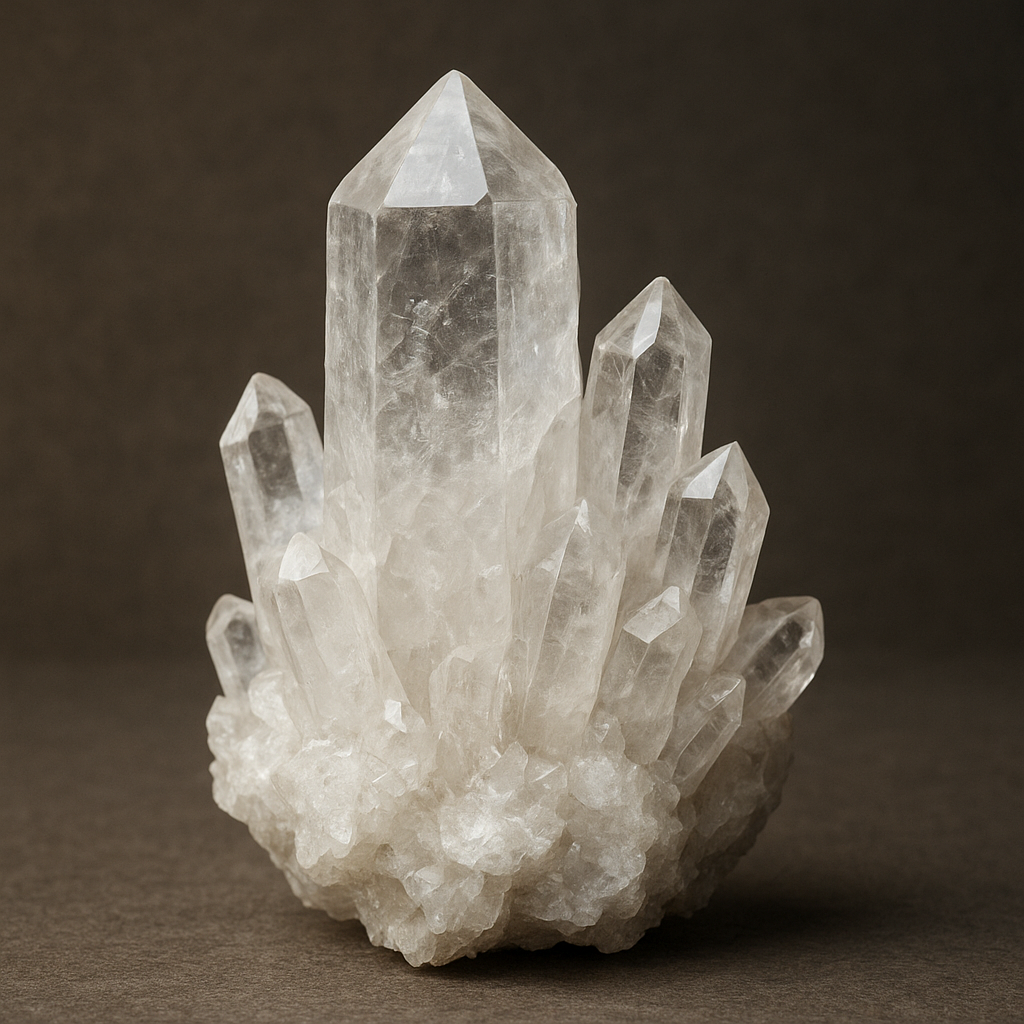

Helvite is a relatively rare silicate mineral that fascinates both scientists and collectors because it sits at the intersection of geology, crystal chemistry and ore formation. Belonging to the **beryl** group and forming a complete solid solution with related minerals danalite, genthelvite and oftedalite, helvite bridges the gap between silicate and sulfide mineralogy. Its honey‑yellow to brown crystals, high manganese content and association with tungsten and tin deposits make it an important indicator of specific geological environments, especially in granitic and skarn systems.
Chemistry, structure and physical properties of helvite
The ideal chemical formula of helvite is (Mn,Fe)4Be3(SiO4)3S, where manganese dominates over iron. This formula already reveals several features that make helvite unusual: it contains the light element beryllium, it is a framework **silicate**, and at the same time it carries sulfur as a discrete anion. As a member of the helvite–group minerals, helvite forms a complete **solid‑solution** series with danalite (where Fe is dominant over Mn), genthelvite (where Zn replaces Mn and Fe), and the rare oftedalite (where Mg is important). In natural crystals, these end‑members usually mix, so precise chemical analyses show gradual changes in composition rather than a single pure formula.
Crystallographically, helvite belongs to the cubic crystal system and crystallizes in a space group that produces a highly symmetrical framework based on corner‑sharing SiO4 tetrahedra. Beryllium also occupies tetrahedral sites, leading to a three‑dimensional network of linked tetrahedra. Within the cavities of this framework sit divalent cations such as Mn2+, Fe2+ or Zn2+, as well as sulfide anions. This combination gives helvite a structure that is both open and robust, somewhat analogous to zeolite frameworks but with much stronger, shorter bonds and higher density.
The presence of **manganese** is responsible for the characteristic color of helvite. Well‑formed crystals are typically pale to deep honey‑yellow, yellow‑brown or sometimes orange‑brown. In some localities, particularly where iron content is higher, the mineral can appear brownish or even slightly greenish. Its luster is resinous to vitreous on fresh crystal faces and often becomes dull on weathered surfaces. The streak is usually white to pale yellow, and in contrast with some opaque manganese minerals, helvite is typically translucent, occasionally approaching transparency in thin fragments.
On the Mohs scale of hardness, helvite ranks at about 6 to 6.5, comparable to feldspar. This makes it relatively resistant to scratching, yet it is more brittle than some common rock‑forming minerals. Cleavage is poor or indistinct, and breakage tends to be uneven to subconchoidal, so helvite fragments show irregular surfaces rather than smooth cleavage planes. These mechanical properties have implications for its behavior during erosion and transport; helvite crystals typically remain attached to their host rock or are found as angular grains in nearby sediments, rather than forming rounded pebbles.
The density of helvite usually lies between 3.1 and 3.4 g/cm3, influenced by how much iron or zinc substitutes for manganese in the structure, since heavier cations raise specific gravity. Under short‑wave or long‑wave ultraviolet light, some specimens may show weak fluorescence, though this is not as diagnostic as in certain other beryllium minerals. Optical properties under polarized light reveal low to moderate birefringence typical for framework silicates, but in practice helvite is more often studied with reflected‑light or electron‑beam methods because of its association with ore minerals.
The structural relationship between helvite and its group members has attracted considerable attention in crystal chemistry. By systematically substituting Mn, Fe, Zn and Mg, researchers can study how different cations distort the tetrahedral framework and modify bond lengths and angles. This in turn helps refine general models of silicate structures and contributes to our understanding of how trace elements partition between coexisting minerals in **hydrothermal** systems and magmatic rocks.
Geological occurrence and world localities
Helvite forms under specific geological conditions that favor the coexistence of beryllium, manganese, silica and reduced sulfur. It is most commonly found in **granite**‑related environments, often associated with pegmatites, greisens and skarn deposits. Because beryllium is a geochemically incompatible element that tends to concentrate in late‑stage magmatic fluids, helvite typically crystallizes from hydrothermal solutions rather than from the main igneous melt itself.
One of the classic environments for helvite is manganese‑rich skarn. Skarns develop where intrusive granitic or granodioritic magmas come into contact with carbonate rocks such as limestone or dolomite. The resulting metamorphic and metasomatic reactions generate calc‑silicate mineral assemblages containing garnet, pyroxene, amphibole and a range of accessory phases. When the circulating fluids are enriched in Be, SiO2 and S under relatively reducing conditions, helvite can precipitate together with scheelite, wolframite or other tungsten minerals, indicating that it may be a useful guide to potential W–Sn–Be mineralization.
Helvite also occurs in quartz veins cutting through granites and related rocks, often alongside fluorite, topaz, cassiterite and sulfide minerals like sphalerite or galena. These veins represent channels through which late hydrothermal fluids escaped from crystallizing intrusions. In such settings helvite may directly coat quartz crystals or fill open cavities, forming sharp, euhedral dodecahedra and tetrahexahedra that are highly prized by mineral collectors.
Several regions of the world are noted for noteworthy helvite localities. In Europe, the Erzgebirge (Ore Mountains) region along the border between Germany and the Czech Republic has produced fine crystals, reflecting its long history as a tin and tungsten mining district. In Scandinavia, Sweden and Norway host helvite in skarn and pegmatitic environments, where it often occurs with genthelvite and danalite, illustrating the full helvite‑group series in a relatively compact region.
China has emerged as one of the most important modern sources of helvite specimens. Provinces with large granitic intrusions and tungsten–tin belts, such as Hunan and Jiangxi, have yielded well‑formed, bright yellow crystals on quartz or fluorite, sometimes reaching several centimeters in size. These specimens have significantly expanded the representation of helvite in museum and private collections and have allowed more detailed studies using advanced analytical equipment.
In North America, helvite is less abundant but still known from selected localities in the United States and Canada. In the U.S., it has been reported from tungsten and beryllium districts in states such as Colorado and New Hampshire, usually as small crystals within greisenized granite or in contact‑metamorphic zones. Canadian occurrences include skarn and granitic environments in British Columbia and the Yukon, though these are more sporadically described in the literature.
Because helvite commonly forms in tight association with ore minerals, its presence can have economic implications. In tungsten‑bearing skarns, for example, helvite may appear together with scheelite and ferberite, marking zones where reactive fluids have interacted with calcium‑ and manganese‑rich host rocks. Similarly, in tin–tungsten greisens that cut granitic cupolas, helvite can coexist with cassiterite, wolframite and topaz. Even though the mineral itself is not normally mined as an ore, its distribution patterns can offer insights into the geometry and evolution of ore‑forming systems, informing exploration strategies.
Microprobe analyses of helvite from different regions reveal subtle variations in composition that mirror regional geochemical trends. Some deposits show elevated zinc contents trending toward genthelvite, while others contain more iron and approach danalite. These variations reflect the chemistry of the parent magma, the composition of surrounding rocks and the redox conditions during mineralization. Because of this sensitivity, helvite serves as a sort of natural recorder of the physicochemical environment in which it formed, preserving information that can be decoded through modern micro‑analytical methods.
Metamorphic overprinting can also influence helvite assemblages. In some orogenic belts, earlier magmatic or skarn‑related helvite has been partially recrystallized or replaced by other manganese minerals during regional metamorphism. Nevertheless, the robust silicate framework allows many grains to survive deformation and heating events that might obliterate softer or more reactive phases. This preservation potential makes helvite useful for reconstructing the pre‑metamorphic history of complex terranes.
Applications, research relevance and collecting aspects
Unlike major industrial minerals, helvite has only limited direct commercial use, largely because of its relative rarity and the dispersed nature of its occurrences. The beryllium content is significant from a geochemical perspective but not concentrated enough to make helvite a primary ore of Be. Industrial extraction of beryllium instead focuses on minerals like bertrandite and **beryl**, which occur in larger, economically viable deposits. However, helvite holds value in several more specialized domains: mineral exploration, academic research and mineral collecting.
In mineral exploration, helvite acts as a pathfinder mineral for certain types of beryllium‑ and tungsten‑bearing systems. Because it tends to form in Be‑enriched hydrothermal environments associated with evolved, often fluorine‑rich granites, its detection in rock samples or heavy‑mineral concentrates can flag the proximity of potentially fertile intrusions. Exploration geologists sometimes use indicator minerals that are more resistant and distinctive than the ore minerals themselves; helvite fills this role in some Sn–W–Be districts, particularly where surface weathering has removed more soluble or softer phases.
Analytically, helvite is an excellent subject for studying crystal chemistry and element partitioning. Its capacity to accept multiple divalent cations (Mn, Fe, Zn, Mg) into structurally equivalent sites offers a natural laboratory for thermodynamic modeling. Researchers can compare measured compositional variations in helvite with coexisting silicates and sulfides to deduce parameters like temperature of formation, redox conditions and fluid composition. In turn, these data help refine broader models of hydrothermal ore formation and crustal fluid evolution.
Modern techniques such as electron microprobe analysis, laser‑ablation ICP‑MS and synchrotron‑based X‑ray diffraction allow scientists to probe helvite at micro‑ to atomic‑scale resolution. Trace elements, including rare earth elements, can be quantified at very low concentrations, revealing subtle zoning patterns within individual crystals. Such zoning frequently records shifts in fluid chemistry over time—episodes of more oxidizing or reducing conditions, influxes of metal‑rich solutions or mixing between deep magmatic fluids and shallow meteoric waters. Through this lens, helvite becomes not just a static mineral, but a time‑resolved archive of geologic processes.
In the realm of experimental petrology, synthetic analogues of helvite‑group minerals are sometimes produced to test theoretical predictions about silicate frameworks. By adjusting pressure, temperature and composition in laboratory vessels, researchers can evaluate the stability fields of helvite relative to competing phases such as spessartine garnet, rhodonite or various manganese oxides. These experiments clarify under what conditions sulfur becomes incorporated into silicate frameworks and how the balance between sulfide and sulfate species shifts with changing redox environments.
Helvite also intersects with environmental and health discussions when beryllium‑bearing minerals are processed or disturbed. Beryllium is a toxic element capable of causing chronic beryllium disease (berylliosis) when fine dusts are inhaled over extended periods. Although helvite is not commonly processed on an industrial scale, any cutting, grinding or high‑temperature treatment of helvite specimens must respect appropriate safety precautions. In practice, the main concern arises in scientific laboratories or during specimen preparation for collections, where operators should employ dust control measures and personal protective equipment when handling finely divided material.
For mineral collectors, helvite holds an enduring appeal. Its bright honey‑yellow color, often contrasted with white quartz or purple fluorite, makes it visually striking. Well‑formed cubic or dodecahedral crystals, sometimes exhibiting complex combinations of faces, are particularly sought after. Because high‑quality pieces are not extremely common and originate from a relatively small number of localities, aesthetic specimens can command substantial prices in the specialty mineral market. Collectors often value helvite not only for its beauty but also for the scientific narrative it carries, connecting the specimen to specific ore‑forming events and tectonic settings.
Micromounters—collectors who focus on very small crystals viewed under magnification—find helvite especially rewarding. In some deposits, the mineral occurs as tiny but perfectly shaped crystals scattered in druses or lining narrow fractures. Under a microscope, these minute crystals reveal sharp edges, growth striations and subtle color variations that are not evident to the naked eye. Micromount collections of helvite and related helvite‑group minerals provide a tangible illustration of how small changes in chemistry translate into differences in morphology and hue.
The educational value of helvite should not be underestimated. In university courses on mineralogy and economic geology, helvite offers an opportunity to discuss several themes at once: beryllium geochemistry, silicate structures, skarn and greisen formation, solid‑solution behavior and the role of accessory minerals as indicators of ore potential. Thin sections containing helvite allow students to practice optical and microanalytical techniques while simultaneously engaging with real‑world questions about mineral systems and resource formation.
From a broader scientific standpoint, helvite symbolizes the intricate ways in which elements are distributed and fixed in the Earth’s crust. The fact that a framework of SiO4 and BeO4 tetrahedra can accommodate sulfide ions and host multiple transition metals reflects the adaptability of silicate structures. This structural flexibility underpins many geological phenomena, from the evolution of granitic magmas to the localization of metal deposits. While helvite itself may be a relatively minor component of most rocks, it encapsulates key principles of geochemistry that extend far beyond its modest abundance.
Current research periodically revisits helvite as analytical tools improve and new localities are discovered. High‑resolution imaging can now detect nanoscale inclusions of fluid or melt trapped within helvite during crystal growth, shedding light on the composition of ancient hydrothermal fluids. Isotopic studies of associated minerals can link helvite‑bearing systems to broader tectonic events such as continental collision, subduction or crustal extension. As such, helvite continues to contribute to the evolving story of how the Earth concentrates and redistributes critical metals through deep time, even if it rarely headlines discussions of major ore commodities.