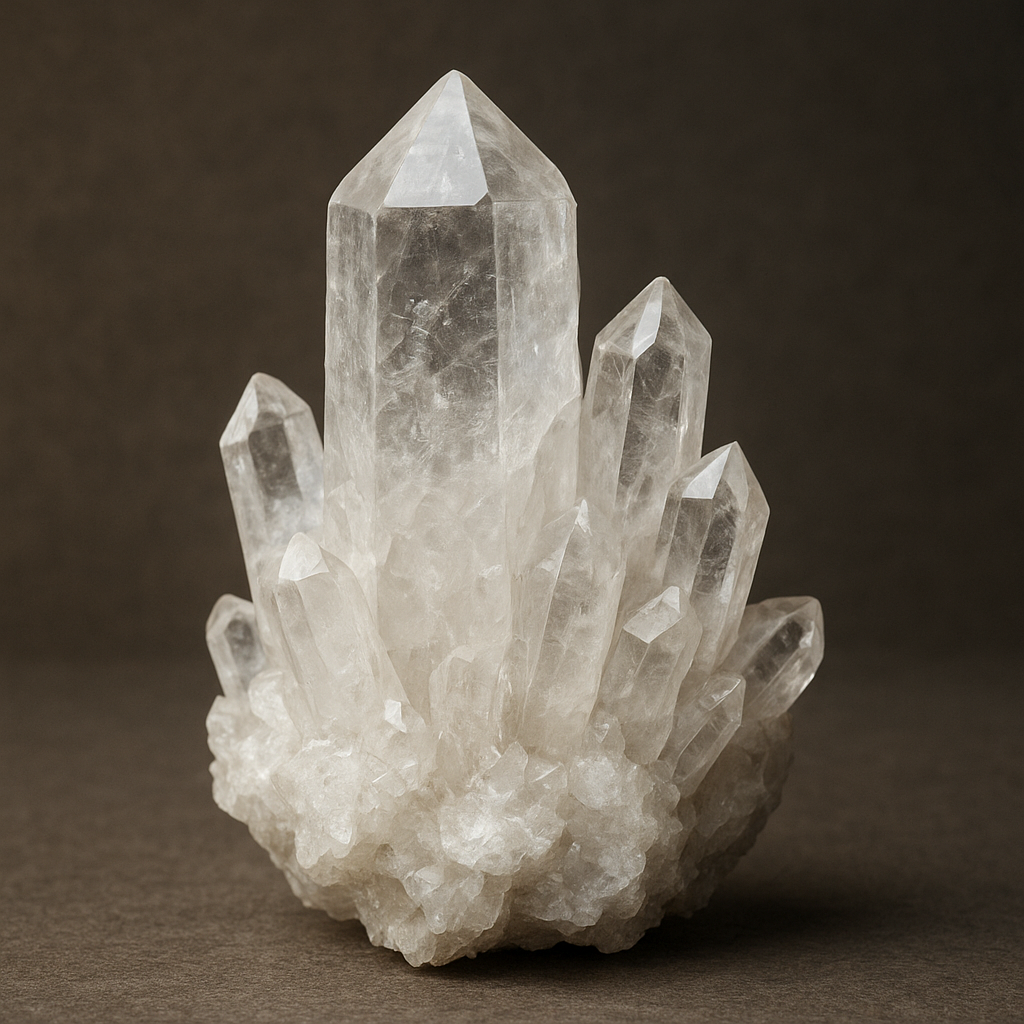

Grossular is a fascinating member of the garnet group, valued both as a gemstone and as an indicator mineral in geology. Its name comes from the botanical term for gooseberry, a reference to the green color of some of its crystals, yet grossular actually appears in a remarkable range of hues, from colorless through honey‑yellow and cinnamon‑brown to vivid green and even rare pinkish tones. Because it bridges the worlds of mineralogy, jewelry, and industrial applications, grossular offers a rich subject for anyone interested in how the Earth’s deep processes translate into beauty and practical uses at the surface.
Chemical nature, crystal structure and varieties
Grossular belongs to the **garnet** supergroup, a family of silicate minerals that share a common crystal structure but differ in chemical composition. Its ideal formula is Ca3Al2(SiO4)3, meaning that calcium and aluminum dominate its lattice, with silicon and oxygen forming the framework of isolated tetrahedra. This arrangement produces a robust **isometric** crystal system, which is why grossular, like other garnets, typically forms well‑defined dodecahedra or trapezohedra with sharp, shiny faces. The strength of this structure is directly linked to its considerable hardness: grossular rates about 6.5 to 7.5 on the Mohs scale, making it suitable for use in rings and other jewelry subject to daily wear.
The color of grossular depends on small substitutions in its crystal lattice by trace elements such as iron, manganese or chromium. Because of this, mineralogists distinguish several well‑known varieties, each of which has achieved its own identity in the gem trade. Among the most sought‑after is **tsavorite**, a vibrant green grossular colored primarily by vanadium and chromium. Tsavorite rivals emerald in saturation and brilliance but tends to show greater clarity and durability, which explains its increasing popularity in high‑end jewelry. Despite its visual similarity to other green stones, its crystal chemistry and formation conditions are distinct, involving metamorphism of vanadium‑rich sediments or rocks.
Another important variety is **hessonite**, often called “cinnamon stone” for its warm orange‑brown to honey color and slightly resinous luster. Hessonite is a calcium‑aluminum grossular enriched in iron and sometimes manganese, giving it a more subdued translucency than the finest tsavorite. Yet it has been cherished for centuries, especially in South Asia, where it plays a role in traditional astrological gem practices. Gem cutters appreciate hessonite for its ability to take a bright polish and for its characteristic “treacly” internal appearance, a subtle texture resulting from microscopic inclusions and growth features.
Also notable is **hydrogrossular**, sometimes referred to as hydro-garnet. In this variety, part of the silica in the structure is effectively replaced by hydroxyl groups associated with water. Hydrogrossular is common in skarn deposits and in metasomatized rocks around limestone intrusions. It often appears in white, pale green, or pinkish colors and is sometimes carved into cabochons and decorative objects. Although not as transparent or brilliant as tsavorite or fine hessonite, hydrogrossular has its own appeal, especially when it shows mottled patterns that resemble jade or other ornamental stones.
Beyond these named varieties, grossular can be colorless, pale yellow, brown, or even slightly reddish. Colorless crystals, although rare, are of great interest to scientists because they demonstrate the “pure” composition of the mineral without significant trace‑element coloring agents. Brownish and yellowish types occur in large masses and can be used as industrial abrasives, in cutting tools, or as filler material, capitalizing on the high **density** and durability typical of the garnet family. In gemology laboratories, spectroscopic techniques are employed to distinguish genuine grossular from imitations and to identify subtle differences between its varieties, which can affect value and classification.
Geological occurrence and formation environments
Grossular forms under a range of metamorphic and metasomatic conditions, especially where calcium‑rich rocks interact with silica‑bearing fluids or melts. One of the classic settings is the **contact** zone around igneous intrusions, where hot magmas encounter carbonate rocks such as limestone and dolostone. The resulting reaction forms skarn, a coarse‑grained, often brightly colored rock composed of garnet, pyroxene, epidote, and other minerals. In these skarns, grossular commonly develops as well‑formed crystals embedded in a mosaic of green and brown silicates, often alongside magnetite, vesuvianite, or wollastonite.
These skarn environments are not only beautiful but economically important. They often host ore deposits rich in iron, copper, tungsten, zinc, and other metals. In this context, grossular acts as an indicator of particular pressure‑temperature regimes and fluid compositions. Geologists mapping and analyzing skarn zones pay close attention to garnet chemistry: the proportion of grossular relative to other garnet components such as andradite or pyrope can reveal subtle changes in rock composition and metamorphic conditions. Microprobe analyses of grossular grains may, for instance, track how fluid chemistry evolved during ore deposition, providing clues about the genesis and potential richness of a deposit.
Another significant environment where grossular appears is in regional metamorphic terrains dominated by calcareous metasediments. In such settings, original **limestone** or marl layers are transformed by heat and pressure during mountain building. The result may be banded marbles and calc-silicate gneisses containing nodules or lenses rich in grossular. These rocks often show delicate color zoning, with greenish, yellow, and brown grossular crystals intergrown with diopside, clinozoisite, and scapolite. Because these rocks can be quite tough and weather‑resistant, they sometimes form ridges or cliffs that stand out in the landscape, subtly influencing local topography.
Notable occurrences are scattered across the globe. In East Africa, especially in **Kenya** and Tanzania, tsavorite-bearing deposits are hosted in metamorphosed sediments and calcareous rocks along fault zones and fold belts. The vibrant tsavorite crystals typically occur in small, fractured pockets, making large clean stones exceptionally rare and therefore highly valued. These deposits are intensely studied because they shed light on the interplay between regional metamorphism, fluid flow, and structural deformation in the East African Orogen. Moreover, their discovery history, beginning in the late 1960s, reflects the role of field prospectors and local communities in opening new pages in gem geology.
In Sri Lanka and parts of India, hessonite grossular is commonly found in alluvial gravels derived from metamorphic source rocks. Over millions of years, weathering breaks down garnet-bearing gneisses and calc‑silicate rocks, releasing durable minerals like grossular into river systems. The high **specific** gravity of grossular causes it to accumulate in placer deposits, where it can be hand‑sorted alongside other gems such as corundum and spinel. Traditional miners in these regions have refined techniques for washing and concentrating heavy minerals, relying on subtle differences in color, luster, and shape to separate grossular from visually similar material.
North America and Europe also host important grossular occurrences, though they are less famous in the gem market. In the Canadian provinces of Quebec and British Columbia, grossular forms in skarn and calc‑silicate rocks associated with intrusions of granitic to dioritic composition. Some of these crystals are gem quality, but many are valued more by collectors and researchers than by jewelers. In Italy and Austria, classic alpine localities yield well‑formed grossular crystals in marbles and metamorphic limestones, often collected by climbers and geologists exploring high mountain terrains. These alpine garnets have contributed significantly to older literature on metamorphic petrology, where they serve as textbook examples of calc‑silicate metamorphism.
Microscopically, grossular often contains inclusions that record the history of the rock. Tiny needles of rutile, bubbles of trapped fluid, or exsolution textures from earlier growth stages can all be preserved inside garnet crystals like time capsules. By studying these inclusions, scientists reconstruct the temperature, pressure, and fluid composition at the time of crystal growth. In some advanced studies, isotopic analyses of oxygen or trace elements in grossular help calibrate models of crustal evolution and metamorphic reactions. This makes grossular not just a decorative gem, but a powerful tool in modern **petrology** and geochemistry.
Uses in jewelry, technology and cultural traditions
Grossular’s combination of durability, luster, and often intense color makes it a prized gemstone. Among the varieties, tsavorite stands at the apex of market demand. Its vivid, slightly bluish to yellowish green hue and high refractive index give it a sparkle comparable to that of other top green gems. Unlike emerald, tsavorite is rarely treated with oils or resins; most stones are sold in a natural state, which appeals to consumers seeking minimally enhanced gems. Fine tsavorite is frequently set in platinum or white gold to accentuate its brightness, and because of its hardness, it is suitable for **engagement** rings, earrings, and pendants intended for everyday wear.
Hessonite occupies a different niche. Its warm orange‑brown shades harmonize well with yellow and rose gold, and jewelers often cut it into ovals or cushions that showcase its syrupy internal glow. While high‑end tsavorite competes with the most expensive colored stones, hessonite often remains more accessible, making it popular for larger statement pieces. In contemporary design, hessonite is sometimes paired with colorless or near‑colorless grossular, or with contrasting gems such as blue sapphire or tourmaline, to create striking color juxtapositions. Antique jewelry from the Victorian era occasionally features brownish and greenish grossular garnets, reflecting the historical taste for richly colored, heavily decorated pieces.
Gemologists value grossular as an instructive species for teaching optical and physical properties. Under the loupe, tsavorite and hessonite reveal diagnostic inclusions and growth patterns, from “sugar‑like” granular textures to fine fluid inclusions aligned along internal planes. When examined with a spectroscope, grossular varieties show distinct absorption bands caused by chromium, vanadium, or iron, allowing professionals to distinguish them from other green or orange stones. Refractive index measurements and **specific** gravity testing further confirm identification, as grossular exhibits a consistent range typical for calcium‑aluminum garnets, in contrast to pyrope- or andradite-dominated compositions.
Beyond the gem market, grossular finds application in various industrial and technological contexts. Coarse, opaque garnet masses, often composed of mixed garnet species with a high grossular component, are crushed and graded as abrasives. These abrasives are used in waterjet cutting, sandblasting, and polishing operations because garnet grains retain sharp edges and do not fracture into dusty, hazardous fragments as easily as some alternatives. In waterjet cutting, garnet‑rich sands enable precise, cool cutting of metals, stone, and composite materials without generating significant heat, an advantage in industries where thermal damage must be minimized.
In some advanced ceramics and glass formulations, grossular or synthetic garnet compositions are studied for their stability and mechanical properties. Research into garnet-structured materials has expanded into fields such as solid-state **battery** electrolytes and laser host crystals. While these applications often involve garnets other than grossular, the fundamental structure shared by grossular provides a reference framework. For example, yttrium aluminum garnet (YAG), famous as a laser material, is structurally analogous to grossular, though chemically quite different. Understanding how natural grossular responds to pressure, temperature, and chemical substitution helps scientists design engineered garnets tailored to technological needs.
In cultural and symbolic terms, grossular has accumulated layers of meaning. In Western birthstone systems, garnet as a group traditionally represents the month of January, signifying constancy, protection, and deep affection. People who favor green stones sometimes choose tsavorite as a modern alternative to emerald, associating it with vitality, growth, and renewal. In South Asian jyotisha (astrological) practices, orange hessonite is linked with the shadow planet Rahu and is believed by some to influence ambition, obstacles, and mental clarity. Clients seeking such stones are often advised to wear them in specific metals and settings, following detailed prescriptions about timing and ritual.
Collectors often seek out grossular specimens that highlight aesthetic and scientific interest simultaneously. A well‑formed tsavorite crystal in its original matrix, showing relationships to neighboring minerals, is much more than a potential gem—it is a record of the metamorphic processes that created it. Museums and university collections display grossular alongside other garnets to illustrate how small changes in chemistry can yield dramatically different appearances. Educational exhibits might pair green tsavorite from Kenya with honey‑colored hessonite from Sri Lanka and white hydrogrossular from Canada, inviting visitors to compare color, transparency, and crystal habit while learning about their geological origins.
Ethical and environmental aspects of grossular mining have become more prominent as awareness grows among consumers. Tsavorite deposits in East Africa, for example, lie in regions of ecological sensitivity and social complexity. Responsible mining initiatives attempt to balance economic benefits with habitat conservation, fair labor conditions, and transparent supply chains. Certification and traceability schemes, though still evolving, aim to give jewelers and buyers greater confidence that the brilliance on display in a ring or necklace has not come at unacceptable social or ecological cost. Similar concerns extend to industrial garnet production, where dust control, water management, and land rehabilitation are central to long‑term sustainability.
As analytical instruments and exploration techniques advance, new occurrences of grossular continue to be documented. Remote sensing, geochemical surveys, and detailed structural mapping help identify potential skarn belts and metamorphic terrains where garnet-rich rocks might lie concealed. For prospectors, an isolated discovery of green or honey‑colored garnet in stream sediments can trigger intensive follow‑up work, tracing the grains back to their bedrock source. For scientists, each newly studied grossular sample adds another data point to global models of crustal evolution, metamorphic fluid flow, and mineral stability. In this way, a mineral that might seem at first to be simply “another gemstone” becomes a key participant in our broader effort to understand the dynamic planet beneath our feet.