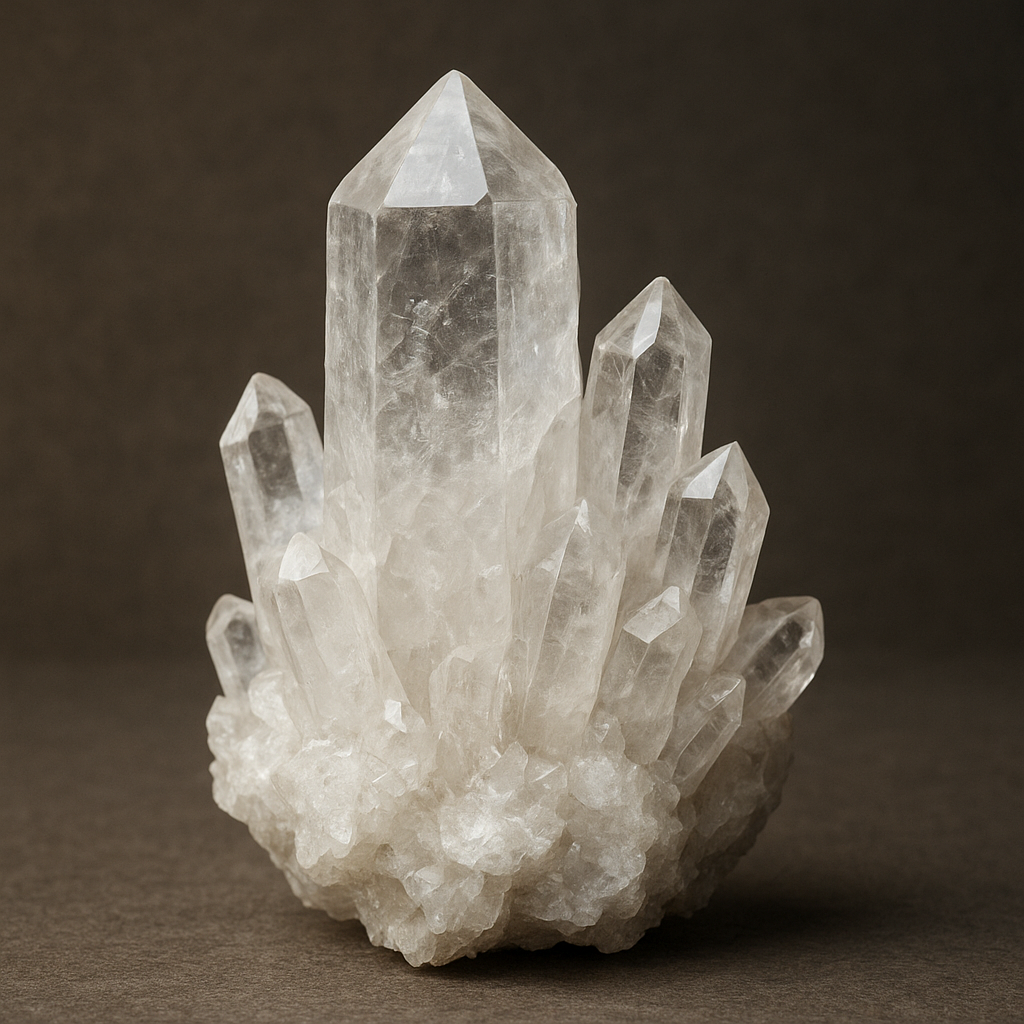

Gehlenite is a fascinating mineral that connects several fields of knowledge: high‑temperature geology, meteorite research, industrial ceramics and even studies of early Solar System processes. Belonging to the melilite group, it crystallizes from calcium‑ and aluminum‑rich melts and occurs in environments where temperatures and chemical conditions differ markedly from those that form more common silicate minerals. Because of its distinctive chemistry and stability at high temperatures, gehlenite plays an important role as a petrogenetic indicator in igneous rocks, a component of refractory industrial materials, and a key phase in the study of calcium–aluminum‑rich inclusions in meteorites.
Chemical composition, structure and physical properties
Gehlenite has the ideal chemical formula Ca2Al(AlSiO7), which can also be written as Ca2Al2SiO7. It belongs to the **melilite** group, a solid‑solution series between gehlenite (aluminum‑rich end‑member) and åkermanite (magnesium‑rich end‑member, Ca2MgSi2O7). In nature, crystals often show compositional zoning between these end‑members, reflecting changing conditions during crystallization. The association with åkermanite is so close that the term “melilite” is frequently used to describe intermediate compositions where the exact end‑member is not specified.
The crystal structure is tetragonal and consists of isolated tetrahedral groups (Si,Al)O4 linked into sheets, with interlayer Ca and Al cations balancing the charge. This framework is relatively open compared to typical framework silicates such as feldspars or quartz, and that structural openness is one reason for the distinctive high‑temperature behavior of gehlenite and related phases. The ordering of Al and Si within the tetrahedral sites is an active research topic, because minor changes in cation ordering can significantly affect stability fields and reaction paths in metamorphic processes.
From a physical standpoint, gehlenite crystals are typically short‑prismatic, tabular or granular, and they often occur as fine‑grained aggregates in complex mineral assemblages rather than as large, well‑formed crystals. The color tends to be pale to dark brown, yellowish, greenish or grey, sometimes nearly colorless in thin section. Luster is vitreous to greasy and the mineral is usually transparent to translucent in small grains.
On the Mohs scale, gehlenite has a hardness of about 6–6.5, placing it in the range of orthoclase feldspar and slightly below quartz. It has a relatively high density (about 2.9–3.0 g/cm3) because of the presence of calcium and aluminum in the structure. Cleavage is poor, and fracture is usually conchoidal to uneven. Under the petrographic microscope, gehlenite in thin section shows low to moderate birefringence, typically with first‑order interference colors, which helps distinguish it from many other rock‑forming minerals.
Optically, gehlenite is uniaxial or weakly biaxial depending on composition and degree of disorder. The refractive indices are relatively high due to the combination of Ca and Al in the structure, making grains stand out distinctly in immersion oils. When identified in thin section, gehlenite is often accompanied by characteristic mineral associations that help confirm its presence, such as grossular garnet, wollastonite, spinel, anorthite and sometimes corundum.
Geological occurrence and formation environments
Gehlenite is not a common rock‑forming mineral in everyday igneous rocks like granite or basalt. Instead, it forms in specialized settings where the bulk chemistry is rich in calcium and aluminum and relatively poor in silica. In many cases it originates either from high‑temperature magmatic crystallization of unusual melts, or from **metamorphic** reactions at elevated temperature in rocks containing carbonate and clay or shale components. These conditions can be reproduced experimentally, and their outcomes give insight into the pressure–temperature paths that produce melilite group minerals.
Contact metamorphic and skarn environments
One of the classic geological settings for gehlenite is within **contact‑metamorphic** zones, where intruding magmas heat and chemically react with surrounding sedimentary rocks. When a magma body intrudes limestone or dolostone that contains impurities such as clay, shale or marl, the carbonate component provides Ca and CO2, while the clays and shales contribute Al and Si. At sufficiently high temperature and relatively low pressure, the release of CO2 and the influx of heat can drive reactions that generate melilite, garnet, spinel and other calcium–aluminum silicates. Gehlenite is one stable phase in this class of reactions, particularly in silica‑undersaturated conditions.
In such contact aureoles, gehlenite usually appears in association with minerals like grossular–andradite garnet, vesuvianite, wollastonite, rankinite, spinel, anorthite plagioclase and sometimes perovskite. These rocks may be classified as calc‑silicate hornfels, skarns or tactites. Gehlenite‑bearing hornfels can form at temperatures of 700–900 °C or even higher near intrusive contacts, and their mineral assemblages provide geothermometric and geobarometric information that helps reconstruct the metamorphic history of the region.
Skarn deposits associated with intrusions into carbonate sequences are also economically significant because they often host ores of iron, copper, tungsten and other metals. Although gehlenite itself is not an ore mineral, its presence can signal specific **high‑temperature** reaction pathways and fluid compositions. Petrologists study the phase relationships of gehlenite in skarns to better understand fluid–rock interaction, transport of metals and the evolution of magmatic–hydrothermal systems that form ore deposits.
Thermally altered limestone, marl and cement‑related rocks
Beyond natural contact aureoles, there are many natural and anthropogenic situations where limestone, marl or clay‑rich sediments are heated enough to generate gehlenite. Natural burning of coal seams, for example, can cause intense local heating in overlying or adjacent sedimentary rocks. In these high‑temperature “baked” zones, unusual assemblages of Ca–Al–Si minerals occur, and gehlenite is sometimes found together with anorthite, spinel, glass and other thermally generated phases.
Anthropogenic environments are especially important. The heating of carbonate‑clay mixtures at industrial scales in cement and lime kilns leads to the formation of mineral phases analogous to those produced in natural contact metamorphism. In some clinker assemblages the phase structurally equivalent to gehlenite may be present as a minor or transient component. Although in modern Portland cement the dominant silicate phases are alite and belite, and the principal aluminate phase is tricalcium aluminate, studies of historical lime mortars and early cements show gehlenite and related melilite phases as intermediate products or minor constituents. Their presence can influence the setting behavior and long‑term durability of historical building materials.
Igneous and volcanic occurrences
In igneous petrology, gehlenite appears in strongly silica‑undersaturated systems such as some melilitites and nephelinites. These unusual volcanic rocks, low in SiO2 but rich in Ca, Al and volatile components, can crystallize melilite group minerals directly from melt. The resulting rocks may be dominated by melilite, nepheline, clinopyroxene and accessory phases like perovskite and spinel. Such rocks are relatively rare compared with classic basalt or andesite, but they occur in several alkaline volcanic provinces worldwide, including parts of Italy, Germany, East Africa and the western United States.
Gehlenite in these magmatic rocks is important for several reasons. First, it constrains the bulk composition and evolution of the melt, indicating that the magma developed under conditions that suppressed quartz and feldspar crystallization. Second, it is a carrier of calcium and aluminum, elements that can also partition into other minerals or glass. Melilite composition is a sensitive indicator of magmatic crystal–liquid equilibria and is used in phase‑equilibrium experiments aimed at understanding the generation of alkaline magmas in the mantle and lower crust.
There are also occurrences of gehlenite in xenoliths – fragments of crustal rocks trapped and transported by ascending magmas. When a mafic or ultramafic magma entrains carbonate‑bearing sedimentary rocks and heats them in transit, partial melting and reaction can generate gehlenite‑bearing assemblages within the xenoliths, providing a snapshot of short‑lived high‑temperature metamorphism deep within the crust.
Metamorphic reactions and stability fields
The presence or absence of gehlenite in metamorphic rocks is controlled by pressure, temperature and bulk chemical composition. In systems rich in CaO, Al2O3 and SiO2, phase diagrams show that gehlenite is stable over a specific range of temperatures, often at low to moderate pressures and relatively low silica activities. As silica activity increases, gehlenite tends to react to form other phases such as anorthite plus spinel or garnet. Conversely, in silica‑poor but alumina‑ and lime‑rich conditions, gehlenite can be among the first silicate phases to crystallize during heating.
Petrologists make extensive use of calculated phase diagrams and experimental runs in the CaO–Al2O3–SiO2–CO2 system to constrain the conditions under which gehlenite appears or disappears. For instance, the reaction of calcite plus kaolinite or clay to form gehlenite plus CO2 and H2O has been studied as an analog for some natural hornfels reactions. Because carbon dioxide is released, these reactions also bear on questions of metamorphic degassing and the role of metamorphism in regional carbon budgets over geological time.
Gehlenite in extraterrestrial materials and cosmochemistry
Beyond Earth, gehlenite plays a prominent role in cosmochemistry, particularly in the study of calcium–aluminum‑rich inclusions (CAIs) in chondritic meteorites. CAIs are among the oldest known solid materials in the Solar System, dated at about 4.567 billion years, and they condensed from the solar nebula at extremely high temperatures. Gehlenite, along with related phases such as grossite, hibonite and spinel, is a key constituent in many of these inclusions.
In CAIs, gehlenite commonly occurs as part of complex layered or nodular structures, surrounded or intergrown with spinel, melilite of varying composition, perovskite and sometimes anorthite. These assemblages display zoning patterns in major and trace elements that record a sequence of condensation, partial evaporation, melting and recrystallization events. The presence of gehlenite, with its characteristic Ca and Al content, is particularly important in thermodynamic models of nebular condensation. According to such models, gehlenite and related phases condense at temperatures above 1300–1400 K from a gas of solar composition.
The mineralogical and isotopic study of gehlenite‑bearing CAIs has revealed anomalies in oxygen, magnesium and calcium isotopes, among others. These anomalies carry information about processes such as mass‑independent fractionation, mixing of different stellar reservoirs, and irradiation by early solar energetic particles. Because gehlenite can host specific trace elements and isotopic signatures, it serves as a **record** of early Solar System conditions, from redox state to dust/gas ratios and gradients in temperature and pressure within the protoplanetary disk.
In addition to meteorites, gehlenite and related melilite phases have been predicted or identified in some interstellar and circumstellar environments. Infrared spectral features observed in dusty envelopes around certain evolved stars and in protoplanetary disks can be matched by mixtures of refractory silicates, including melilite group minerals. Laboratory measurements of the optical spectra of synthetic gehlenite at high temperatures allow astrophysicists to interpret these observations and to infer the composition and evolution of cosmic dust populations.
Industrial relevance and technological applications
Although natural gehlenite is mainly of petrological interest, synthetic gehlenite and melilite solid solutions play an increasingly significant role in materials science and technology. The combination of high‑temperature stability, moderate thermal expansion, and relatively simple chemistry makes gehlenite‑type phases attractive as model systems and, in some cases, as functional materials.
Cement, clinker and construction materials
In Portland cement and many related binders, the principal crystalline phases are calcium silicates and aluminates, but there is growing interest in low‑CO2 cements based on alternative chemistries. Melilite‑type phases, including gehlenite, appear in experimental clinkers designed to reduce the amount of limestone required or to incorporate industrial wastes rich in CaO and Al2O3. Understanding the hydration and durability of these phases is crucial to assess their potential as main or supplementary constituents of new cements.
Gehlenite itself is relatively inert with respect to hydration compared with traditional clinker minerals like alite. However, in finely ground form and in the presence of reactive aluminates or supplementary cementitious materials, it can participate in complex reaction networks that influence setting time, heat evolution and long‑term strength. Research in this area connects mineralogy, civil engineering and environmental science, because the replacement of conventional clinkers by melilite‑rich alternatives could significantly lower global CO2 emissions from cement production.
In addition, understanding the stability and decomposition of gehlenite‑like phases in clinker is relevant for the durability of concrete exposed to high temperatures, such as in fires or in specialized industrial structures. Some refractory concretes and castables for furnaces, kilns and incinerators may deliberately or incidentally form gehlenite upon heating, and their thermo‑mechanical properties partly depend on the presence of this phase.
Refractories, ceramics and glass–ceramic materials
Because gehlenite is stable at high temperatures and compatible with other Ca–Al–Si phases, it is a useful component of certain refractory ceramics and glass–ceramic composites. Synthetic gehlenite can be prepared by solid‑state reaction or sol–gel techniques from mixtures of calcium, aluminum and silica sources. When incorporated into ceramic matrices, it can modify thermal expansion, mechanical strength, microstructure development and chemical resistance. Its melting behavior and interaction with slags also matter in high‑temperature metallurgical processes.
Glass–ceramic materials based on the CaO–Al2O3–SiO2 system often crystallize gehlenite or melilite as a principal phase upon controlled heat treatment. These materials can exhibit tailored properties: low thermal expansion, high thermal shock resistance and good mechanical strength. Such properties are valuable for cookware, heat‑resistant panels and components in thermal insulation systems. Gehlenite crystallization from glass can sometimes be undesirable if it leads to internal stresses or opacification; therefore, glass technologists study its nucleation and growth to either promote or suppress this phase as needed.
Another industrial niche involves the immobilization of hazardous wastes and the valorization of industrial by‑products. Fly ash, metallurgical slags and red mud often contain significant amounts of CaO, Al2O3 and SiO2. When these materials are processed into glass–ceramics or sintered ceramics, gehlenite may form as one of the principal crystalline phases. Its ability to incorporate certain minor and trace elements into its structure can aid in the immobilization of heavy metals and radionuclides, creating stable matrices for long‑term storage or use in construction.
Functional materials and potential high‑tech uses
While gehlenite is not as widely used as perovskite or spinel in functional materials, there is ongoing research into its potential as a host lattice for luminescent ions, ionic conductors or catalysts. The flexible tetrahedral framework and the presence of calcium and aluminum sites that can be partially substituted with rare‑earth or transition‑metal ions make it a candidate for phosphors and optical materials. Preliminary studies have explored doped melilite compositions for luminescence applications in lighting and displays, though commercial adoption remains limited.
There is also interest in the dielectric and insulating properties of melilite ceramics. The combination of moderate permittivity, good thermal stability and resistance to chemical attack could make gehlenite‑based ceramics suitable for specific niche applications in electronics, particularly at elevated temperatures or in corrosive environments. Research in this direction typically involves adjusting composition along the melilite solid solution series, since small variations in Mg, Al and Si content can fine‑tune dielectric behavior.
Analytical methods and research techniques
To investigate gehlenite in natural and synthetic samples, mineralogists and materials scientists employ a range of analytical methods. Identification often begins with optical microscopy in thin section or polished section, where texture, birefringence and association with other minerals provide initial clues. Because gehlenite can be compositionally variable and is easily confused with related melilite phases, more precise techniques are usually required.
X‑ray diffraction (XRD) is the primary tool used to distinguish gehlenite from other silicates and to measure unit‑cell parameters that reflect composition. Powder XRD patterns show characteristic reflections of the tetragonal melilite structure, and the exact peak positions can reveal where a sample lies along the gehlenite–åkermanite join. Rietveld refinement of high‑quality diffraction data allows determination of cation distribution between tetrahedral and octahedral sites, a detail that is important for thermodynamic modeling.
Electron microprobe analysis (EMPA) and scanning electron microscopy (SEM) provide quantitative chemical compositions at micrometer scales, enabling the mapping of zoning patterns in single crystals or aggregates. Back‑scattered electron imaging shows compositional contrasts, while wavelength‑dispersive spectroscopy measures concentrations of major and minor elements. These methods have been particularly fruitful in studies of gehlenite‑bearing CAIs, where subtle gradients in Mg, Al and rare‑earth elements can reflect complex histories of evaporation, condensation and partial melting.
Transmission electron microscopy (TEM) and related high‑resolution techniques reveal defects, stacking irregularities and nano‑scale exsolution or intergrowths within gehlenite. Such features can influence mechanical and thermal properties in ceramics and glass–ceramics and can also record deformation and recrystallization processes in natural rocks. In cosmochemical contexts, nanometer‑scale inclusions or zoning within gehlenite grains may carry isotopic and chemical signatures of brief, high‑temperature events in the early Solar System.
Isotopic analyses using secondary ion mass spectrometry (SIMS) and multi‑collector inductively coupled plasma mass spectrometry (MC‑ICP‑MS) allow researchers to study trace‑element partitioning and isotopic anomalies in gehlenite. For instance, Mg and Ca isotopes in gehlenite from CAIs have been central to discussions of the short‑lived radionuclide 26Al and its role as a heat source in planetesimals. The ability of gehlenite to incorporate specific trace elements like rare‑earth elements makes it a powerful archive of astrophysical and geochemical processes.
Environmental and archaeological significance
While gehlenite itself is not typically a pollutant or an environmental hazard, it can appear in contexts related to human impacts on the environment and cultural heritage. For example, the mineral may form in the high‑temperature zones of industrial waste incinerators, cement kilns or coal‑burning power plants, as ash and slag cool and crystallize. Identifying gehlenite in these materials can help engineers understand temperature histories, reaction pathways and the long‑term stability of solidified wastes.
In environmental mineralogy, the occurrence of gehlenite within sintered or vitrified wastes is often viewed as beneficial, because it signals that Ca–Al–Si phases have crystallized into relatively stable structures. These structures tend to immobilize heavy metals better than amorphous glass alone, reducing leaching into soils and groundwater. Consequently, process optimization may deliberately favor the crystallization of melilite group phases to improve the performance of engineered waste forms.
In archaeology and heritage science, gehlenite can provide clues about ancient technologies. When ancient potters, lime burners or metalworkers heated calcareous clays or marls to high temperatures, they sometimes inadvertently formed gehlenite in ceramic bodies, kiln linings or slags. Modern analytical techniques can detect this mineral, and its presence helps estimate firing temperatures and raw material compositions. Such data contribute to reconstructions of ancient production methods, trade networks and technological evolution.
Gehlenite has been identified in some historical mortars and plasters, particularly where local raw materials contained both limestone and aluminous clay, and where firing or burning temperatures became especially high. By studying this and related phases, conservators can better understand the durability and weathering behavior of heritage structures and can design compatible restoration materials that reproduce original mineralogical characteristics.