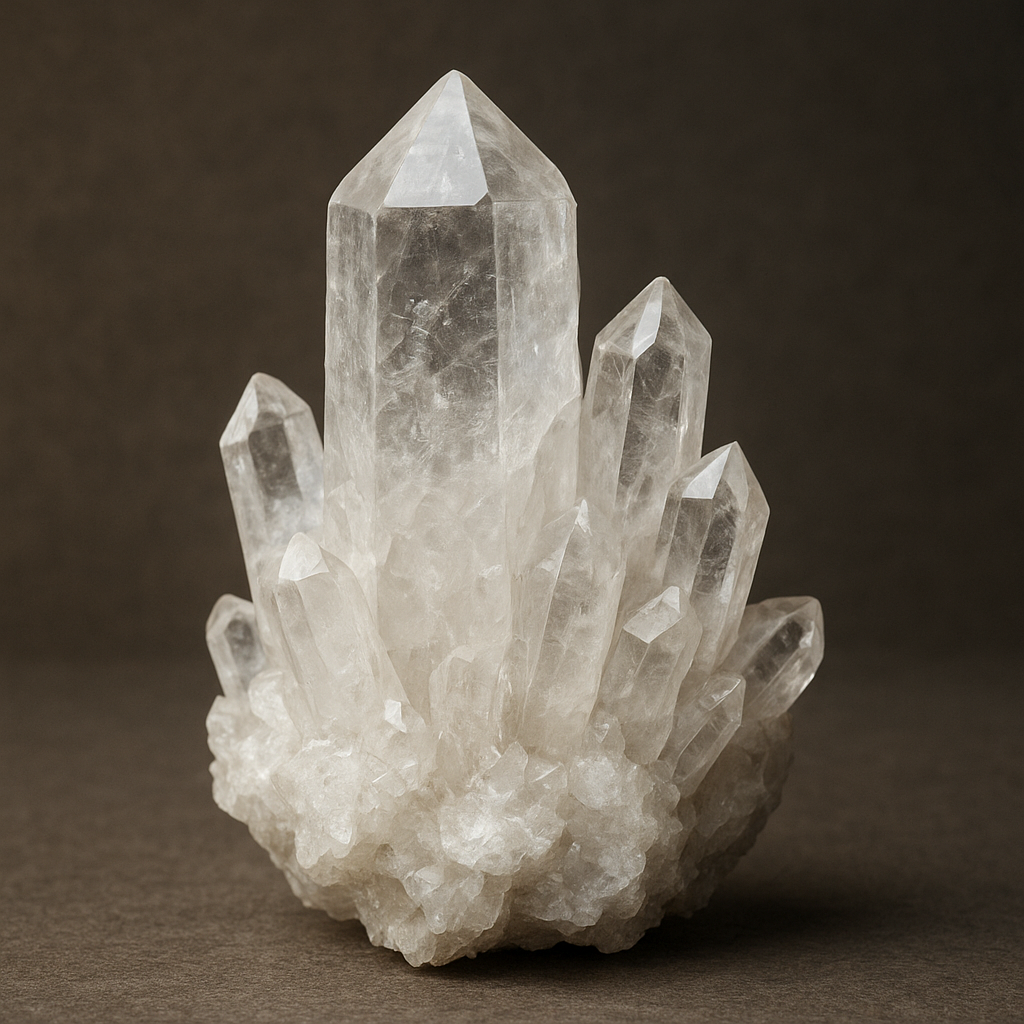

Anglesite is a fascinating secondary mineral that forms through the alteration of lead sulfide ores, especially galena. Known for its high density, adamantine luster and often striking transparency, it occupies an important place at the crossroads of **mineralogy**, **geology**, **mining**, environmental science and even historical collecting. Although not as famous as quartz or calcite, anglesite reveals a great deal about the chemical weathering of ore deposits, the mobility of lead in the near-surface environment and the development of classic mining districts around the world.
Chemistry, crystal structure and physical properties of anglesite
Anglesite is a lead sulfate mineral with the ideal chemical formula **PbSO4**. It belongs to the orthorhombic crystal system and forms part of the barite group, which also includes barite (BaSO4) and celestine (SrSO4). In this isostructural group, the large cation (Pb, Ba, Sr) occupies similar positions in the crystal lattice while the sulfate tetrahedra (SO4) remain relatively unchanged. This structural similarity explains why anglesite can sometimes form solid solutions or close associations with its sulfate relatives in nature.
Crystals of anglesite are commonly prismatic or tabular, often with a short, thick habit, but they may also appear as pyramidal or dipyramidal forms. Twinning is not unusual and can generate complex and aesthetically pleasing crystal aggregates that are prized by **collectors**. Massive, granular or earthy habits occur in heavily altered ore zones, where distinct crystals have been partly dissolved or overgrown by other minerals.
One of the most striking characteristics of anglesite is its very high specific gravity, typically around 6.3. This extreme density reflects the dominance of the heavy lead cation within the structure. Even small, transparent crystals feel unexpectedly heavy in the hand, which is a useful diagnostic property in the field. The luster is usually adamantine to resinous, especially on fresh faces, and can become somewhat dull on weathered surfaces.
In terms of color, anglesite is often colorless to white when pure, but more commonly appears pale gray, yellow, greenish or even brownish because of trace impurities, inclusions or radiation damage in old specimens. Some crystals from oxidized lead deposits may show zoning, with clearer cores and more strongly tinted rims. Streak is white, and the transparency ranges from transparent through translucent to opaque in massive material.
Anglesite has a Mohs hardness of about 2.5–3, making it relatively soft and easy to scratch with a knife, yet somewhat harder than galena. Cleavage is typically distinct in one direction, less so in others, and fracture is uneven to conchoidal. These properties, together with its brittleness, mean that large, undamaged crystals are uncommon and must be handled carefully.
Optically, anglesite is biaxial and exhibits high refractive indices, which contribute to its notable brilliance when cut and polished. Strong dispersion can give faceted stones an appealing “fire”, but the softness, brittleness and lead content make it unsuitable for everyday **jewelry**. Instead, faceted anglesite is mainly of interest for gemstone enthusiasts and museum collections as a rare and educational curiosity.
Chemically, anglesite forms primarily through the oxidation of galena (PbS). When lead sulfide is exposed to oxygenated water, the sulfide component is gradually converted to sulfate while the lead remains, resulting in the precipitation of lead sulfate: anglesite. In highly oxidizing, sulfate-rich conditions, anglesite is stable, but in carbonate-rich environments it can further transform into lead carbonate, cerussite (PbCO3). As a result, in many oxidized lead ore zones anglesite closely coexists with cerussite, and careful petrographic or chemical analysis is needed to separate them.
Geological occurrence and global distribution
Anglesite typically occurs as a secondary mineral in the oxidation zones of lead ore deposits. These zones develop near the surface where descending meteoric waters introduce oxygen and weak acids to primary sulfide minerals. As galena and associated sulfides (such as sphalerite and chalcopyrite) are weathered, a rich assemblage of secondary minerals forms, including anglesite, cerussite, pyromorphite, wulfenite and sometimes mimetite or vanadinite. Anglesite is often found coating galena crystals or infilling fractures and cavities within altered ore.
From a geological perspective, oxidized lead deposits serve as natural laboratories for studying fluid–rock interaction and redox processes. The vertical zoning of minerals, from primary sulfides at depth through sulfates and carbonates in the intermediate zone to clay-rich gossans at the surface, reflects the progressive interaction of ore bodies with the atmosphere and hydrosphere. Anglesite, positioned as an intermediate product between galena and later minerals, helps geologists reconstruct the evolution of these systems.
Anglesite is widely distributed, though usually not in large concentrations when compared with more abundant gangue minerals like quartz or calcite. Classic localities include the type area on the island of Anglesey in Wales, where the mineral was first described in the 19th century and from which its name is derived. The old Parys Mountain and related mines yielded significant anglesite as part of complex polymetallic deposits rich in copper and lead. These localities remain historically important for understanding British mining and mineralogy.
In continental Europe, notable anglesite specimens have been collected from the Freiberg district in Germany, the Harz Mountains, and various deposits in Spain, Italy and France. In many of these regions, centuries of underground mining exposed vast oxidation zones where anglesite could crystallize in open spaces. Some European mines, now long closed, became celebrated sources of museum-quality crystals that continue to circulate among collectors worldwide.
North America has also produced remarkable anglesite occurrences. In the United States, significant localities include the lead-zinc districts of the Missouri–Kansas–Oklahoma region, parts of Colorado and Utah, as well as classic deposits in the Mississippi Valley–type province. In these carbonate-hosted ores, the interplay between sulfate-bearing waters and carbonate rocks often leads to the juxtaposition of anglesite with cerussite, barite and smithsonite. Canada contributes localities from its own lead-bearing districts, particularly in regions where near-surface weathering of sulfide bodies has been intense.
Elsewhere in the world, anglesite is known from lead mines in Mexico, Morocco, Namibia, South Africa, Australia and several Asian countries. Some of the visually most attractive crystals are found in arid or semi-arid climates where slow weathering and low vegetation cover favor the preservation of delicate crystal forms inside vugs and cavities. For mineralogists, the diversity of global occurrences provides comparative case studies on how local climate, host rock and groundwater chemistry affect the stability fields of lead sulfate versus lead carbonate minerals.
Beyond its typical setting in classic ore districts, anglesite can occasionally appear in more unusual geological contexts. For instance, it may form around smelting slag heaps, abandoned mine tailings or near other anthropogenic sources of lead contamination where sulfide-bearing materials are exposed to atmospheric oxidation. In such environments, anglesite becomes a mineralogical signature of human impact on geochemical cycles, bridging natural and industrial processes.
Anglesite in mining, metallurgy and economic geology
While galena is the principal primary ore of lead, secondary minerals like anglesite also contribute to the overall **resource** in heavily oxidized deposits. Historically, miners working near the surface often encountered zones rich in cerussite and anglesite before reaching the more continuous sulfide ores at depth. These oxidized ores could be more easily worked with simple technologies because they were softer, more friable and sometimes amenable to direct smelting without complex roasting operations.
Anglesite itself serves as a minor lead ore, particularly in districts where the oxidation zone is thick and sulfides have been largely depleted. Its high lead content—more than 68% by weight in the pure mineral—means that, where available in sufficient tonnage, it can be economically valuable. However, most modern lead production still relies on galena, with anglesite playing a subordinate role and often being processed alongside cerussite and other secondary phases.
From a metallurgical standpoint, anglesite behaves differently from sulfide minerals during processing. Sulfide ores require roasting to convert PbS to PbO or PbSO4 before reduction to metallic lead in a furnace. Anglesite, being already an oxidized sulfate, may be reduced more directly under the right conditions. In some hydrometallurgical schemes, anglesite can be leached using appropriate reagents to extract lead into solution, followed by precipitation or electrowinning. Understanding these differences is essential for designing efficient flowsheets when oxidized lead ores form a significant proportion of a deposit.
In **economic** geology, the presence of anglesite marks the upper, oxidized portion of lead ore systems. Its vertical and lateral distribution, together with companion minerals, helps exploration geologists infer the depth to primary sulfides and the overall size of the ore body. For instance, an extensive blanket of anglesite and cerussite at the surface may indicate a substantial underlying galena zone that was once connected to the oxidized cap by groundwater flow paths. Conversely, thin or patchy anglesite development may suggest limited weathering or a small underlying sulfide lens.
The mobility of lead during the transformation from galena to anglesite is also of practical interest. Under some conditions, lead released from decomposing galena can be transported short distances in solution before re-precipitating as anglesite or other secondary minerals. This small-scale redistribution can enrich certain zones while depleting others, altering the local metal grade. Detailed mineralogical mapping of anglesite and fluid inclusion studies in associated gangue minerals help reconstruct such processes and refine ore models.
Although anglesite is not a major industrial **commodity** in its own right and has few direct technological applications, its role as a lead carrier intersects with broader issues around the demand for lead in batteries, shielding and specialized alloys. As the global economy shifts, and as environmental regulations tighten around lead use, the economic relevance of oxidized lead ores and their mineralogy—including anglesite—continues to evolve. Deposits once neglected may become viable again through improved extraction techniques or changing market needs.
Anglesite, environmental geochemistry and contamination
Because anglesite is a lead-bearing mineral that forms near the Earth’s surface, it stands at the interface between geology and **environmental** science. Weathering of lead sulfide ores and mine wastes releases lead into soils, sediments and waters, where it poses toxicity risks to ecosystems and human populations. Anglesite, along with cerussite and other secondary phases, can act both as a temporary sink for lead and as a potential source of future contamination, depending on local geochemical conditions.
In oxidizing and sulfate-rich environments, lead tends to precipitate as anglesite, especially when carbonate activity is low. This immobilization is beneficial in the sense that dissolved lead concentrations can drop as the solid sulfate forms. However, anglesite is not completely inert. Changes in pH, redox potential or sulfate availability may allow partial dissolution, releasing lead back into groundwater. In carbonate-rich settings, anglesite may transform to cerussite, which is somewhat more stable under neutral to slightly alkaline conditions but still vulnerable to weathering.
Soils in historic mining camps and smelter sites often contain fine particles of anglesite, mixed with remnants of galena, slag fragments and other anthropogenic materials. Because anglesite can occur as a fine, sometimes dusty alteration product, it may be easily ingested or inhaled by humans and animals, creating a pathway for lead exposure. Detailed mineralogical characterization of contaminated soils helps remediation specialists understand which lead phases dominate, as their solubility and bioavailability differ significantly.
Environmental geochemists use a range of analytical techniques—such as X-ray diffraction, scanning electron microscopy and synchrotron-based spectroscopy—to identify anglesite and distinguish it from other lead compounds. These methods reveal not only the presence of PbSO4 but also its association with iron oxides, clay minerals or organic matter. Such information is crucial for predicting how lead will behave over decades or centuries, as climates and land uses change.
In some remediation strategies, engineers aim to transform more soluble lead phases into less soluble ones. For example, phosphate amendments are sometimes added to contaminated soils to promote the formation of lead phosphates, which are typically more stable and less bioavailable than anglesite or cerussite. Understanding the thermodynamic stability and dissolution kinetics of anglesite under various conditions allows practitioners to design more effective treatments and to anticipate long-term outcomes.
Another important dimension concerns acid mine drainage. In sulfide-rich mine waste piles, oxidation of pyrite and other sulfides generates acidic waters that can mobilize lead, zinc and other metals. As such waters move away from the source and mix with less acidic groundwater, conditions change and secondary minerals precipitate. Anglesite can form in transitional zones where sulfate levels remain high but acidity begins to decline. Monitoring where and how much anglesite forms can thus provide indirect insights into the evolution of mine drainage plumes and the success of neutralization efforts.
Beyond strictly mining-related environments, anglesite may appear in urban or industrial settings where lead-containing materials and sulfates coexist. For instance, on weathered lead-based paints or roofing materials exposed to sulfate-rich atmospheres, thin crusts of anglesite have occasionally been observed. These micro-environments, though small in scale, are of interest for understanding how lead migrates in the built environment and how it might be stabilized.
Anglesite as a collector’s mineral and in gemology
In the world of mineral collecting, anglesite holds a respected position as a classic secondary lead mineral. Enthusiasts prize well-formed, transparent crystals with sharp faces and intense luster. Because of its softness and brittleness, intact anglesite specimens from old mines are increasingly rare and command high prices in specialized markets. The combination of high density, optical brilliance and often subtle coloration makes it visually distinctive in any collection.
Historically, some of the finest anglesite specimens came from the famous lead mines of England and Wales, including the type locality in Anglesey. These mines produced crystals perched on massive galena, sometimes accompanied by quartz, calcite or fluorite. Over time, many of these working mines closed, rendering the original sources inaccessible. As a result, existing specimens have become part of a finite historical record, preserved in museum drawers and private cabinets.
In addition to British localities, collectors value anglesite from Moroccan and Mexican deposits, which have yielded unusually large and transparent crystals. Some of these crystals have been cut into faceted stones to showcase anglesite’s optical properties. While such gemstones display strong brilliance and attractive dispersion, their practical use is extremely limited. With a hardness around 2.5–3 and pronounced cleavage, anglesite chips and abrades easily, and its high lead content raises concerns about skin contact if worn as daily adornment.
Nonetheless, within **gemology** anglesite provides an instructive example of a mineral that is beautiful yet impractical for mainstream jewelry. It is occasionally cut into collector stones that reside in sealed cases, used as teaching specimens or incorporated into specialized research on high-refractive-index materials. Gemological instruments such as refractometers and spectroscopes can readily distinguish anglesite from look-alike gems because of its characteristic optical constants and absorption features.
For field collectors, safety considerations are important when handling and storing anglesite specimens. Lead-bearing minerals should not be ground, cut or polished without proper protective equipment, as inhalation or ingestion of dust can be harmful. Children should not handle raw anglesite unsupervised. Responsible collectors typically wash their hands after handling specimens, store them in closed cabinets and clearly label them as containing lead.
Anglesite also plays a role in museum displays that address the history of mining and the dual nature of mineral resources—as both economic assets and potential contaminants. Exhibits may juxtapose anglesite crystals from renowned ore districts with information on lead poisoning, industrial uses of lead and environmental remediation. In this way, the mineral becomes a tangible link between natural beauty, technological advancement and social responsibility.
Research, analytical techniques and scientific significance
Anglesite attracts scientific interest from several directions: mineralogy, crystallography, surface chemistry, environmental kinetics and even planetary science. Because it has a relatively simple composition yet complex environmental behavior, it serves as a model system for studying how heavy metals interact with aqueous solutions and common rock-forming minerals.
In crystallography, detailed X-ray diffraction studies have refined the positions of atoms within the anglesite structure, shedding light on bond lengths, coordination environments and subtle distortions caused by impurities or pressure. These data are used to compare anglesite with barite and celestine, helping to illuminate how cation size influences lattice parameters and physical properties. Such comparisons can feed into larger databases used in geophysical modeling, such as predicting the behavior of sulfate minerals at elevated pressures and temperatures.
Surface science research focuses on how anglesite crystals interact with water, dissolved ions and organic molecules. Techniques such as atomic force microscopy, surface spectroscopy and microcalorimetry reveal how quickly the mineral dissolves under various pH and redox conditions, which functional groups on organic ligands bind most strongly to lead sites and how surface defects influence reactivity. These findings inform environmental models that attempt to predict lead mobility in soils and aquifers containing anglesite.
Isotopic studies add another layer of insight. Lead has several stable isotopes whose ratios vary among geological reservoirs and ore-forming events. When anglesite inherits lead from its parent galena, it preserves these isotopic signatures, albeit with potential minor fractionation during weathering. Geochemists can exploit this information to trace the origins of lead contamination in rivers or soils, linking modern pollutants back to specific mining districts or industrial sources. In this context, anglesite functions as a forensic marker in environmental investigations.
Experimental petrology and thermodynamic modeling also benefit from accurate data on anglesite’s stability. By performing controlled dissolution–precipitation experiments, scientists derive equilibrium constants, solubility products and reaction rate laws. These parameters are then incorporated into geochemical software used to simulate natural systems, such as the evolution of an oxidizing ore body or the performance of a mine tailings cover designed to minimize metal leaching.
Although less commonly discussed, anglesite has potential relevance to planetary science. Lead and sulfur are present in many extraterrestrial materials, and sulfate minerals have been detected on Mars and in certain meteorites. While anglesite itself has not been conclusively identified beyond Earth, understanding its formation conditions and spectroscopic signatures helps prepare scientists to interpret remote sensing data from other planets where lead and sulfate might coexist. In this way, a mineral rooted in terrestrial ore deposits becomes a stepping stone toward interpreting the mineralogy of other worlds.
Finally, anglesite contributes to the pedagogy of earth sciences. Its clear relationship to galena and cerussite makes it an exemplary mineral for teaching about supergene enrichment, oxidation–reduction reactions and the vertical zoning of ore deposits. Laboratory exercises might have students examine thin sections of galena partially replaced by anglesite, analyze powder diffraction patterns or calculate theoretical densities and compare them with measured values. Through such activities, students gain a concrete understanding of how chemical principles manifest in real rocks and minerals.